ETNA: EnTropy regularization for compressed Neural Avatar

Proceedings of BMVC 2026

Guillaume Loranchet1,2 João Regateiro1 Bharath Bhushan Damodaran1 Franck Galpin1 Adnane Boukhayma2 Franck Multon2 Pierre Hellier2
1 InterDigital, Rennes, France     2 Univ Rennes, Inria, CNRS, IRISA, Rennes, France

Abstract

The growing demand for realistic and controllable virtual humans in large-scale applications such as online multi-user environments, gaming, and shared immersive realities raises challenges for memory efficiency and bandwidth usage. While implicit neural representations (INRs) provide a powerful alternative to explicit mesh-based avatars, they often require large neural networks whose parameters are not optimized for compression, limiting scalability. We introduce an entropy regularization framework for neural implicit avatar representations that shapes the weight distribution during training, making it suitable for standard compression schemes. Our approach adds regularization losses, including a differentiable soft-entropy loss and a L1 loss between quantized and unquantized weights, enabling the network to minimize entropy while maintaining high-fidelity geometric reconstruction. Unlike Quantization-Aware Training (QAT), our method does not require a custom forward pass and is meant to be used jointly with post-training compression tools. Experiments on DFaust, including unseen identities and poses, demonstrate significant reductions in model size while preserving generative capabilities and show improvements over standard PTQ and QAT baselines. Entropy regularization enables robust compression at lower bitrates without sacrificing visual fidelity and reconstruction accuracy.

Overview

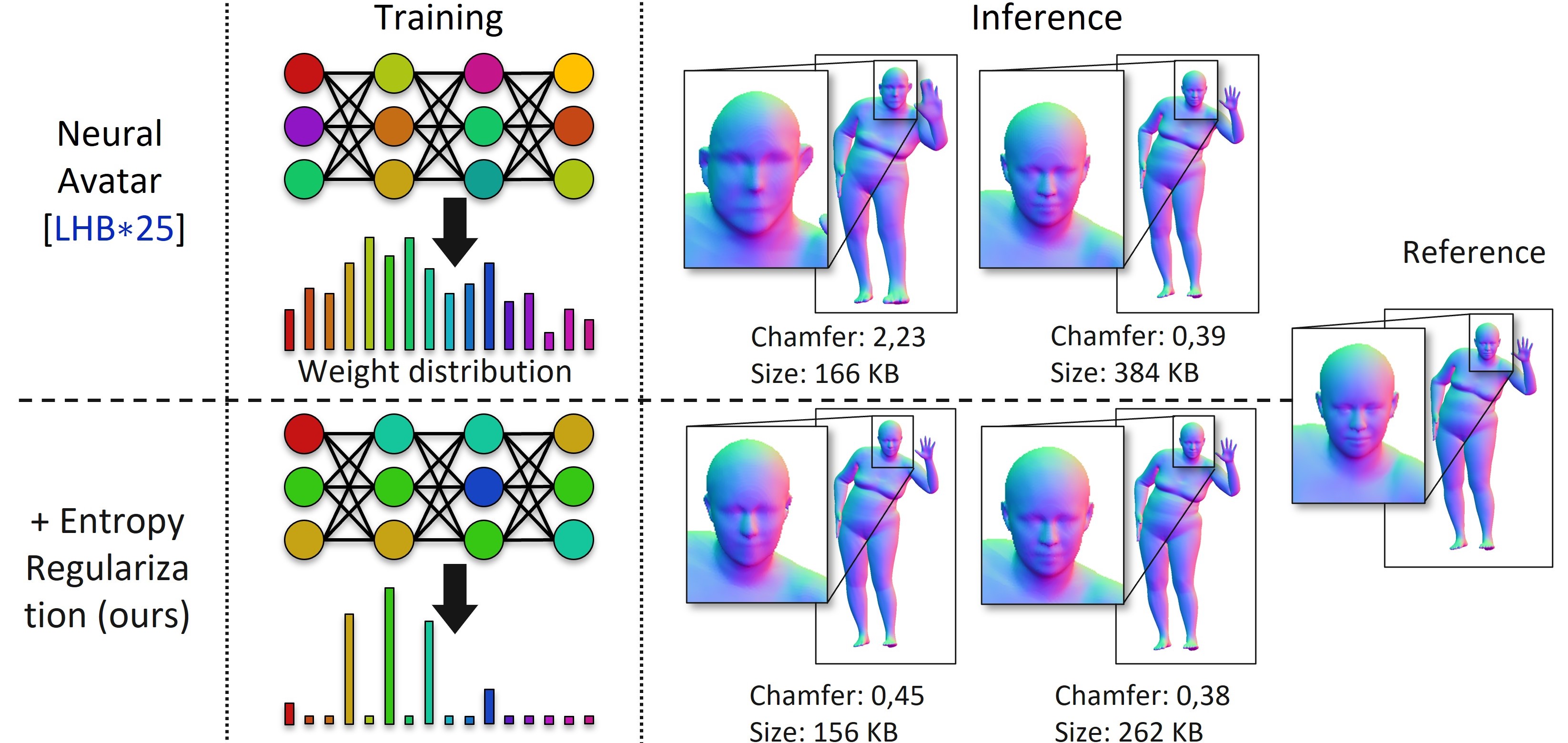
ETNA method overview comparing baseline LHB and entropy-regularized LHB

Figure 1 (Paper): ETNA shapes the weight distribution of implicit virtual human models during training so that an off-the-shelf range coder achieves smaller checkpoint sizes while preserving visual fidelity and reconstruction quality.
Training & Fine-Tuning with Entropy Regularization

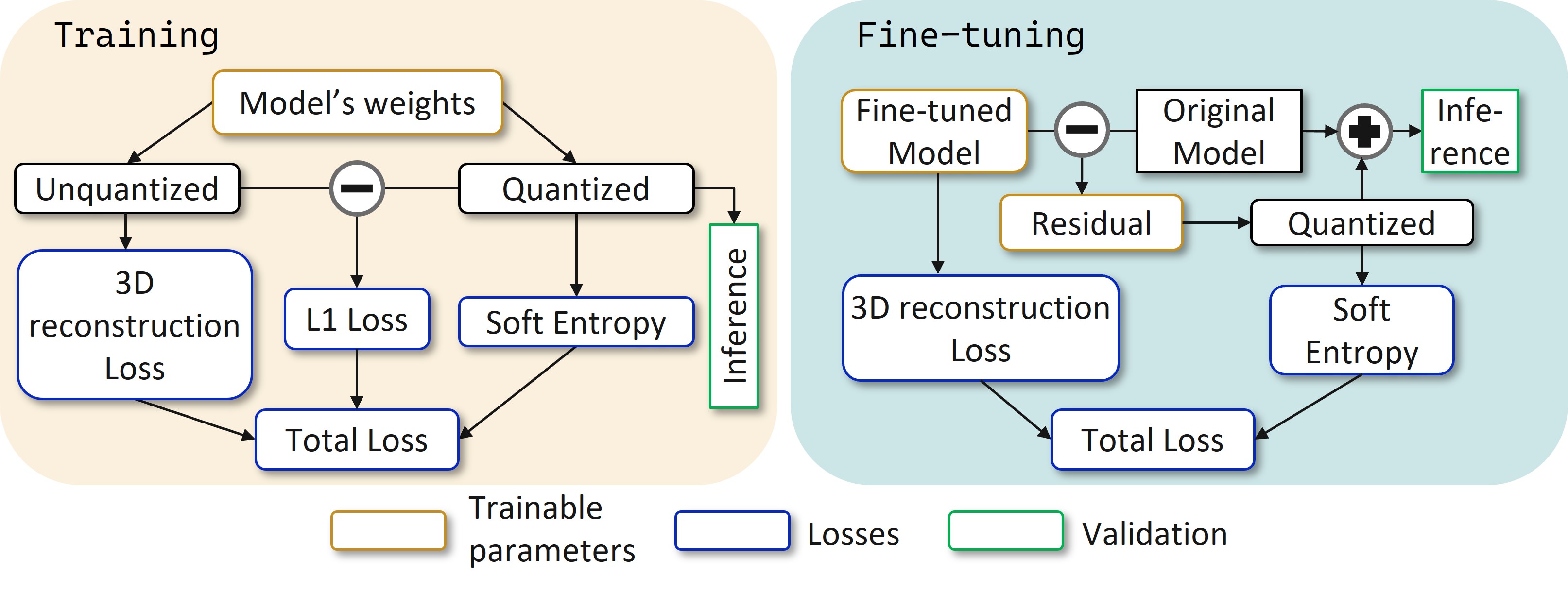
Unlike Quantization-Aware Training (QAT), ETNA leaves the model's forward pass unchanged: unquantized weights \(W\) are used to compute the 3D occupancy reconstruction loss \(\mathcal{L}_R\), while quantized weights \(W^q\) drive the soft-entropy regularizer \(\tilde{H}\) and the boundary penalty \(\mathcal{L}_{\max}\) over fixed bounds \([b_{\min}, b_{\max}] = [-2, 2]\). An \(L_1\) alignment term keeps \(W\) and \(W^q\) close, and Stochastic Weight Averaging (SWA) stabilizes convergence:

\[ \mathcal{L} = \lambda_R \mathcal{L}_R + \lambda_{L_1} \mathcal{L}_1(W, W^q) + \lambda_{\max} \mathcal{L}_{\max} + \lambda \tilde{H}. \]

When personalizing a shared base avatar to a new identity via teacher–student fine-tuning, the same regularization can be applied directly to the weight residual between the original and fine-tuned models, substantially reducing the size of identity-specific bitstreams.

Block diagrams of training and fine-tuning pipelines with ETNA entropy regularization

Figure 2 (Paper): Block diagrams of model training (left) and identity fine-tuning (right) with the proposed entropy regularization. Both pipelines keep the forward pass unmodified during training and evaluate inference using quantized weights.

Differentiable Soft-Entropy Computation

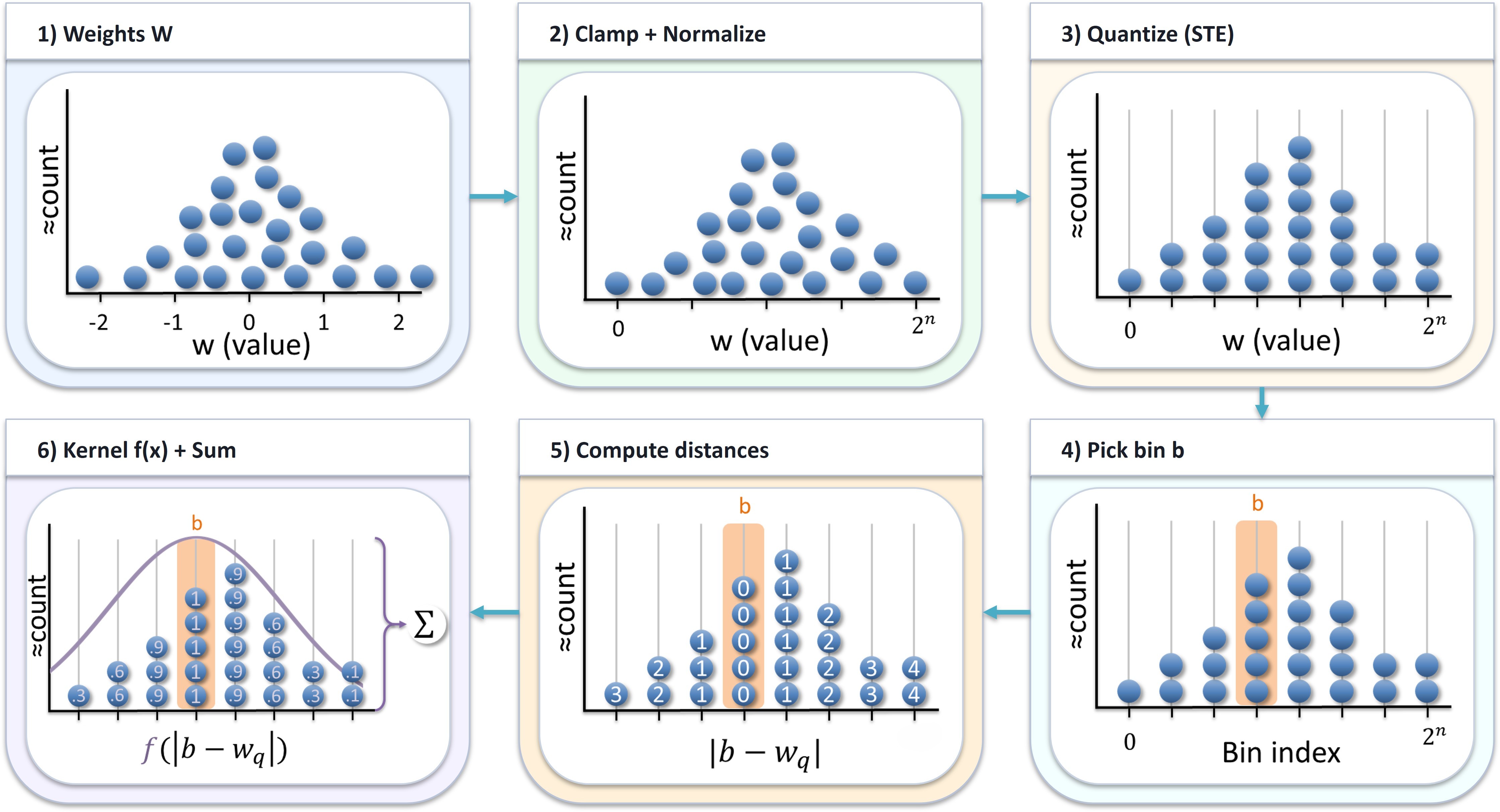
All learnable weights are concatenated into a flattened tensor \(W \in \mathbb{R}^T\), clamped to fixed boundaries \([b_{\min}, b_{\max}]\), normalized to \([0, 1]\), and quantized to \(n = 10\) bits using the Straight-Through Estimator (STE):

\[ W^q = \Big(\lfloor w_{\text{norm}} \times (2^n - 1) \rceil\Big)_{w_{\text{norm}} \in W_{\text{norm}}}. \]

To make histogram counting differentiable across the \(2^n\) integer bins, each bin count is approximated via a Gaussian kernel \(f(x) = e^{-\sigma x^2}\) with fixed \(\sigma = 0.1\):

\[ C(b, W^q) = \sum_{w^q \in W^q} f(w^q - b), \qquad p(b) = \frac{C(b, W^q)}{T}, \qquad \tilde{H} = -\sum_{b} p(b) \cdot \log_2\!\big(p(b) + \varepsilon\big). \]

6-step diagram of differentiable soft-entropy computation

Figure 1 (Supplementary): Overview of the 6-step soft-entropy computation. Unquantized weights (1) are clamped and normalized (2), quantized with STE (3), and compared against every bin \(b\) (4–5) using kernel \(f(x)\) to obtain differentiable soft counts and entropy (6).

Qualitative Results on Unseen Poses

We evaluate ETNA on two multi-identity implicit neural avatar models—LHB and COAP—compressed with a lossless range coder. Adjusting the entropy weight \(\lambda\) provides finer rate-distortion control than lowering the quantization bit-depth \(q\) alone, preserving recognizable identity and clean geometry at low bitrates.

LHB Comparison (MPI PosePrior ulr1d)

Figure 3 (Paper): Meshes obtained with LHB for a challenging unseen pose. Left: unregularized LHB quantized to \(q = 7, 8, 10\). Right: LHB with entropy regularization (\(\lambda = 650\) and \(\lambda = 250\) at \(q = 10\)). At \(\lambda = 250\), ETNA matches the \(q = 10\) Chamfer distance (\(0.44\text{ cm}\)) with less than half the file size (\(172\text{ KB}\) vs. \(384\text{ KB}\)), and avoids severe distortion at low bitrates (\(117\text{ KB}\) vs. \(166\text{ KB}\)).

COAP Comparison

Figure 4 (Paper): Meshes obtained with COAP for an unseen pose. Left: COAP PTQ baselines (\(q = 7, 9, 10\)). Right: COAP with entropy regularization (\(\lambda = 5\) and \(\lambda = 0.1\) at \(q = 10\)). At \(\lambda = 0.1\), ETNA halves the encoded size (\(326\text{ KB}\) vs. \(641\text{ KB}\)) while achieving higher IoU (\(0.80\) vs. \(0.78\)).

Quantitative Results

Use the tabs or arrows below to switch between the rate-distortion curves comparing ETNA against Post-Training Quantization (PTQ), Quantization-Aware Training (QAT), and NNCodec residual compression on unseen identities and poses of DFaust.

1 / 3
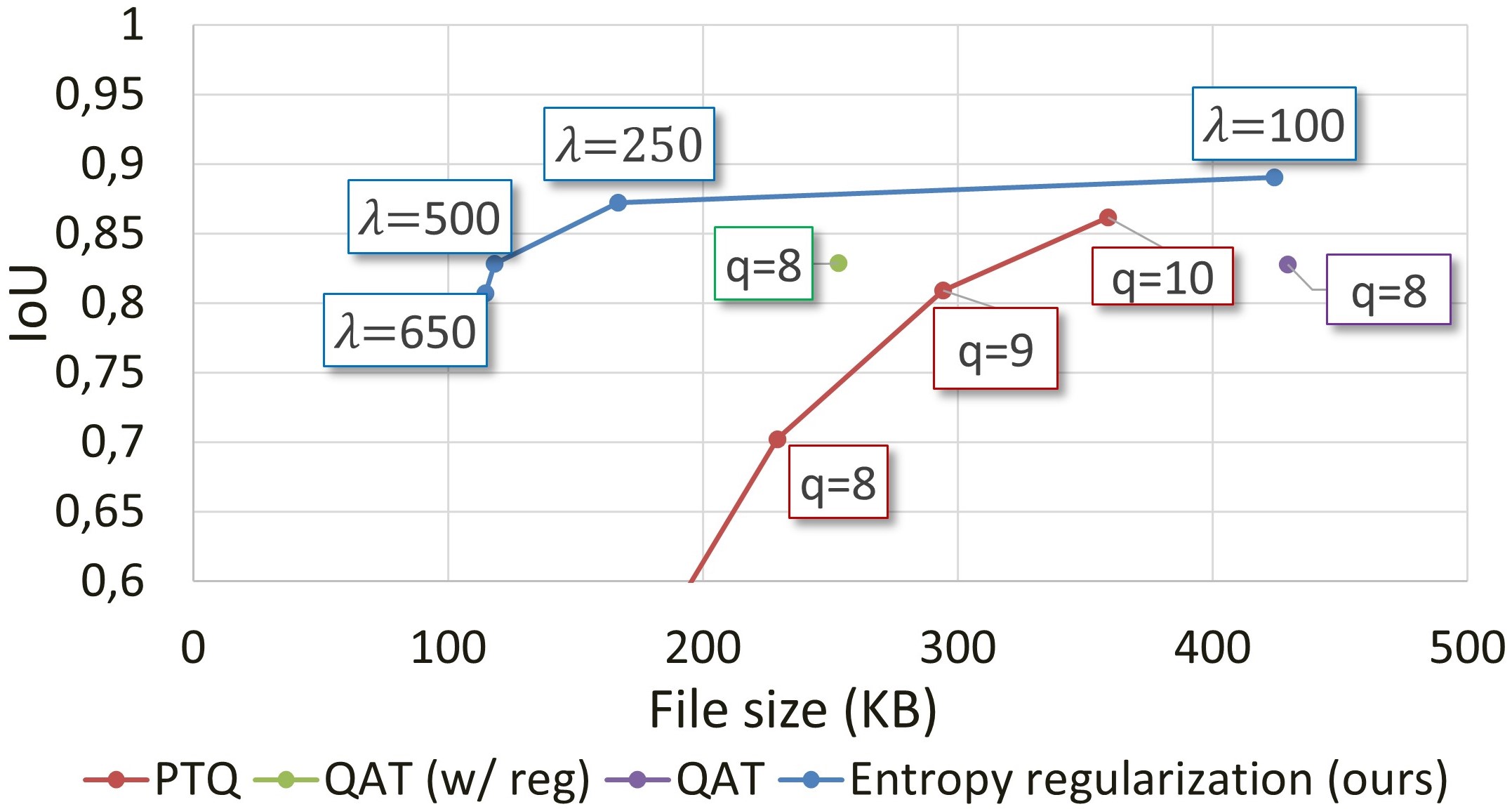
LHB IoU versus file size comparing ETNA, QAT, and PTQ

Figure 5(a) (Paper) — LHB: Surface IoU versus range-coded checkpoint size (KB) on unseen identities and poses. Entropy regularization (blue, \(q=10\) with varying \(\lambda\)) consistently outperforms PTQ (red), QAT without regularization (purple, \(q=8\)), and QAT with regularization (green, \(q=8\)).

Model Size, Parameter Entropy, and Reconstruction Quality (Table 1)

Generative Model Total Params (M) Entropy (bits/param) Total Bits (M) Chamfer Dist (cm)
SMPL Female 5.22 20.00 104.35 N/A
gDNA 31.13 24.45 761.25 N/A
COAP 1.27 16.02 20.30 0.49
Fast-SNARF 0.52 18.98 9.86 0.30
LHB 0.52 18.99 9.92 0.30
COAP + Regularization (ours) 1.27 2.97 3.77 0.47
LHB + Regularization (ours) 0.52 2.40 1.25 0.30

Table 1 (Paper): Entropy regularization reduces parameter entropy by roughly 8× on LHB (from 18.99 to 2.40 bits/param) and over 5× on COAP (from 16.02 to 2.97 bits/param) on the synthetic DFaust dataset without degrading Chamfer distance.

BibTeX

@inproceedings{loranchet2026etna,
  author    = {Loranchet, Guillaume and Regateiro, Jo{\~a}o and Damodaran, Bharath Bhushan and Galpin, Franck and Boukhayma, Adnane and Multon, Franck and Hellier, Pierre},
  title     = {{ETNA}: {EnTropy} regularization for compressed {Neural Avatar}},
  booktitle = {Proceedings of the British Machine Vision Conference (BMVC)},
  year      = {2026}
}